TAG-195 Enhances Malware Tactics with Modular Framework and New Variants
Executive Overview
The Insikt Group recently identified four new malware families emerging from the TAG-195 ecosystem, known informally as "Golden Chickens" or “Venom Spider.” This ecosystem is becoming one of the more recognizable names in the field of malware-as-a-service (MaaS). The families—dubbed "TinyEgg," "ChonkyChicken," and a modular variant of ChonkyChicken, alongside "ChromEggscalator"—illustrate a distinct evolution in TAG-195's approach, adapting to the pressing needs and tactics of the cyber threat landscape. Given TAG-195's previous collaborations with entities like TAG-127, which has utilized TinyEgg through strategies such as deceptive security verification pages, this evolution raises alarms for cybersecurity analysts who’ve seen firsthand the implications of such advancements.
Architectural Shifts in TAG-195
What’s particularly striking about these new strains is the pronounced shift towards modular design within the MaaS framework. TinyEgg, for instance, acts as a lightweight backdoor; its primary function is to enable host profiling and shell access—critical for maintaining persistent control over compromised systems. Then there’s ChonkyChicken, which builds on this foundation by introducing sophisticated features like browser credential theft and session automation. Such capabilities significantly enhance reconnaissance operations, enabling adversaries to gather intelligence more efficiently. The modular ChonkyChicken variant goes a step further by employing a controller-and-plugin architecture. This architectural choice is a marked advantage, as it allows the main implant to request specific functionalities dynamically based on operational requirements—without the need to bundle all features upfront.
Moreover, TAG-195 has repurposed an existing Chrome encryption-bypass tool, transforming it into a specialized module known as ChromEggscalator. This kind of innovation highlights a responsiveness within the group that’s vital for remaining elusive to defenders. Despite the different functions of these four malware families, they share key architectural blueprints: they utilize consistent command-and-control frameworks, a unified persistence strategy, and similar obfuscation techniques. These commonalities are not just coincidental; they reflect a deliberate design philosophy that significantly affects how these tools can be deployed in the wild.
Implications for Security Professionals
The shift to a modular architecture introduces several implications for those tasked with cybersecurity. This could markedly enhance the stealth of TAG-195's operations, allowing them to craft more adaptive strategies that evade traditional detection measures. As malware becomes increasingly selective about its deployment, it also signals shifts in economic motivations within the MaaS landscape, prioritizing efficiency and impact. For security professionals, this evolution necessitates an urgent reassessment of detection methods; strategies should emphasize ClickFix-style clipboard execution monitoring, the potential misuse of legitimate system tools for payload delivery, and scrutiny of suspicious persistence mechanisms during system startup. These measures could serve as essential front-line defenses against the latest threats.
Key Insights
- Insikt Group’s findings illustrate that TAG-195 is actively evolving its malware offerings, with the newly identified families reflecting a strategic move toward modular, user-centric tooling.
- The updated ChonkyChicken variant employs a controller-and-plugin model, empowering operators with customized capabilities while minimizing risks of detection.
- Shared features among the four malware families point to a clear design philosophy deeply rooted in the TAG-195 ecosystem, evident through filename gating, consistent persistence strategies, and legitimate routes of execution.
Background on TAG-195
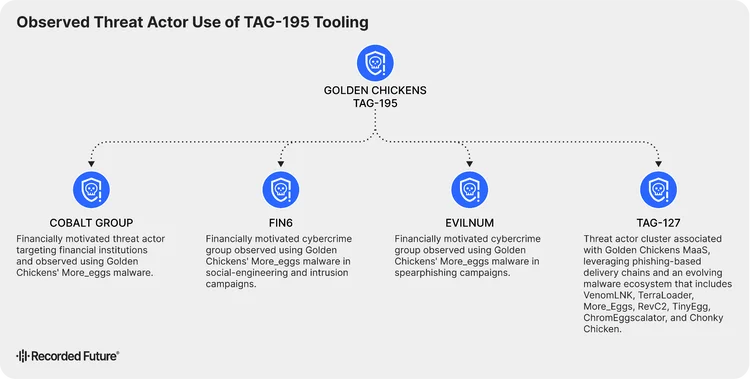
TAG-195 has carved out a reputation as a financially driven MaaS developer, positioning itself as a notable player in the cybercrime market. The group’s portfolio is heavily focused on tools aimed at credential theft and remote access, indicating a specialization that caters to the various needs of cybercriminal actors. Their established reliability as a service provider is underscored by the malware they make accessible to a range of threat groups. Previous investigations have linked TAG-195's tactics to high-profile criminal factions like FIN6, the Cobalt Group, and Evilnum, suggesting it supports a niche clientele. While the group's marketing tactics and access frameworks remain somewhat opaque, it’s clear that the systemic interconnections between these actors create a persuasive case for monitoring TAG-195's activity closely.
Future Outlook and Significance
Given TAG-195’s trajectory, the implications for cybersecurity are more significant than they may appear at first glance. The move towards modular designs indicates that cybercriminals are not only innovating in terms of functionalities but are also refining their operational strategies to avoid detection. This should serve as a wake-up call for businesses and security teams alike. The trend encourages a more proactive stance in threat hunting and incident response. If you’re working in this space, you may need to rethink your framework for assessing and responding to threats.
As TAG-195 continues to adapt and evolve, the community must stay vigilant. The adoption of such modular frameworks offers attackers the flexibility that legacy systems cannot match. This is the kind of issue that often gets overlooked but should remain front and center in cybersecurity discussions. Cybersecurity professionals need to acknowledge that malware offerings are becoming increasingly user-centric, demanding tailored approaches to mitigate their effects. The future isn’t just about detection; it’s about anticipation and adaptability in response to ever-changing tactics.