DoppelCart’s 261,700 Suspected Fake Shops Show How Fraud Infrastructure Persists
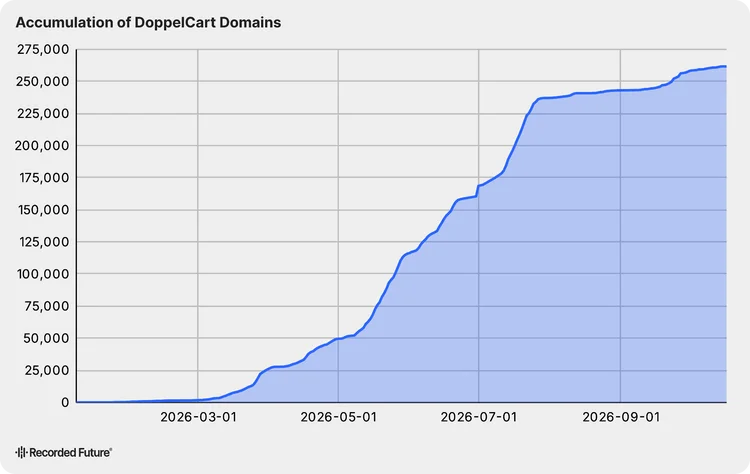
DoppelCart’s reach appears to come from persistence as much as expansion. Recorded Future identified about 261,700 suspected domains tied to the online shopping fraud network, and roughly 40% of the observed sites remained active as of October 17, 2026. For retailers, the scale points to a continuing brand impersonation problem even as the pace of new domain detections slows. A large count of domains doesn’t establish how many shoppers were exposed or how much money was lost, but it does show why a falling rate of new detections can give a misleading picture of the threat. If existing storefronts remain online, the network can keep presenting shoppers with opportunities to mistake a fake shop for a familiar retailer.
How the storefronts deceive shoppers
German cybersecurity company Nebty first exposed DoppelCart in September 2026, identifying more than 119,000 websites. The storefronts copy legitimate retailers’ product listings, images and descriptions, then lure shoppers with steep discounts, including offers of 65% off. Most used .shop domains. The method depends on borrowing the signals people use to judge an online store: familiar products, recognizable images and prices low enough to encourage a quick purchase. A convincing page can make those signals feel reassuring, even when the domain itself has no connection to the retailer being copied.
Shared designs, code and infrastructure linked thousands of sites, though Nebty said this did not prove that one criminal group operated the entire network. Reporting by Malwarebytes and BleepingComputer described checkout pages that send personal and payment data to attacker-controlled servers in real time. Some sites also collect bank-issued one-time verification codes, which could let criminals authorize transactions while shoppers believe they’re paying a legitimate retailer. That detail raises the stakes: a fake shop may be built to collect information that helps complete a payment, not simply to take an order and disappear. The precise capabilities may differ among sites, especially given the uncertainty about how many operators are involved.
Domain growth slowed, but many sites stayed online
Using proprietary methods, Recorded Future identified about 261,700 unique apex domains likely connected to DoppelCart, primarily from March through October 2026. Detections began appearing in the thousands in January and rose in March, reaching their peak in June and July. New host detections fell sharply from August onward. The timeline describes what the researchers detected, rather than providing a direct count of shoppers, transactions or losses. That distinction matters: domain activity is a useful measure of the network’s visible footprint, but it can’t by itself explain how frequently people encountered the shops or how much harm they caused.
That slowdown doesn’t necessarily mean the operation is winding down. It may reflect operators maintaining already registered domains instead of adding new ones. Recorded Future’s web scans found that around 40% of suspect sites observed before October 17 remained active, a sign that identifying and disabling individual storefronts may leave a substantial pool of impersonation sites in circulation. The active share also puts the headline count in perspective: a detection can remain relevant after the rush of new registrations has passed. Here’s the thing: defenders watching only for fresh domains could miss the continued exposure created by older sites that still load and appear ready to take orders.
Why persistence changes the response
For retailers, this is more significant than it looks. A brand can work to remove a fake storefront and still face copies using similar names, product pages and checkout flows elsewhere. The reported scale suggests that impersonation needs to be treated as a recurring operational problem, with attention to both newly detected sites and previously identified ones that remain active. That work can be difficult to measure from outside: a domain count doesn’t tell a company which pages its customers saw or whether a removal effort reached them in time.
For shoppers, familiar branding and a polished product page aren’t enough to establish that a store is genuine. If you’re working in this space, the reported use of real-time data collection and one-time codes is a reminder that checkout deserves as much scrutiny as the storefront. A discount may be the hook; the information entered at payment is the deeper risk. The convenient appearance of an online shop can conceal a very different purpose. And yet, the reporting doesn’t establish that every domain linked to DoppelCart behaves identically, so the network’s overall footprint shouldn’t be mistaken for a single uniform operation.
What the figures can—and can’t—tell us
Recorded Future’s estimate gives defenders a way to understand the suspected network’s breadth, while the active-site finding points to its persistence. Together, they make a stronger case for sustained monitoring than a simple month-by-month count of new detections would. Still, the estimate is based on proprietary methods and domains considered likely to be connected to DoppelCart; it isn’t a confirmed inventory of sites run by one group. The uncertainty around ownership also matters when interpreting shared code and infrastructure, since common technical features can link sites without proving who controls each one.
The useful takeaway is a measured one. The detection slowdown is a sign about observed growth, not proof that the fraud has ended, and the active sites show why that distinction matters. There’s still a large pool to contend with. Retailers and shoppers are left with a familiar problem in a more visible form: copied storefronts can persist, and the evidence available so far describes the scale of the web presence more clearly than its financial impact.