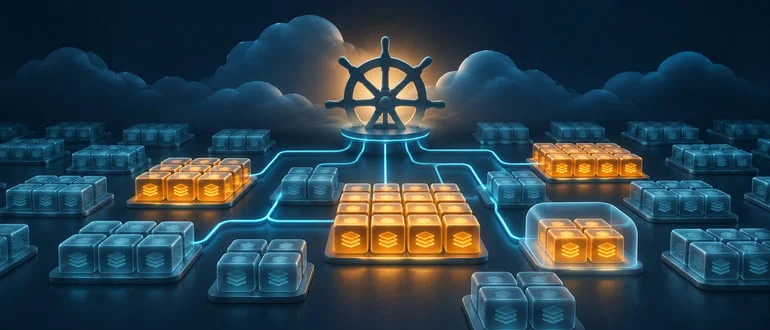
Cosmonic Packs 1.42 Million Wasm Sandboxes Onto One Kubernetes Server
Cosmonic ran 1.42 million sandboxed environments on a single 64-core server, and it did so inside a Kubernetes cluster running wasmCloud. The demo was shown this week at KubeCon + CloudNativeCon North America 2026. The raw number grabs attention, but the implication matters more: a lot of AI agent work may not need a full virtual machine or even a conventional container.
Company CTO Bailey Hayes pitched it as an alternative way to deploy agents. Instead of provisioning heavy infrastructure for each one, IT teams could run WebAssembly sandboxes that scale on Kubernetes clusters they already operate. That's a pitch aimed squarely at platform teams, who are already juggling one set of tooling for web services and another for everything agents need. Here's the thing: density demos are easy to stage and harder to translate. A single server holding a large number of sandboxes tells you about the overhead of each one, not whether those sandboxes are doing useful work at the same time.
Where Wasm fits, and where it doesn't
Hayes's view is that WebAssembly suits agents with a narrow, well-defined job. That describes most of what enterprises will actually deploy. Think of a bot that checks invoices or triages support tickets. Each one gets an isolated sandbox, and that isolation matters more than the density figure. Without it, an agent can reach services and applications it should never touch, and that's the failure security teams will worry about first.
That said, Wasm isn't the answer for everything. An AI coding agent that needs a broader toolchain may still call for a larger sandbox built on a micro virtual machine, Hayes noted. The split is sensible, if a little tidy. Few enterprises will run only one class of agent, and the article doesn't say where the line falls in practice. A coding agent that needs a compiler and a package manager sits clearly on one side, and the invoice bot sits clearly on the other. Most real agents will land somewhere in between, and that's where the decision gets hard.
Kubernetes wasn't built for this
Cosmonic's case rests on wasmCloud, an open-source platform with a Kubernetes Operator for deploying Wasm components. Hayes argued that AI agents could become the "killer application" for the project, which is now moving forward as an open-source project under the Cloud Native Computing Foundation (CNCF). I'd treat that phrase as a hypothesis rather than a finding. Vendors reach for "killer application" when they're betting on a use case that hasn't yet proven itself at scale.
The bigger problem sits underneath the sandbox. Today, every active agent gets its own pod. An idle agent still ties up memory and CPU, and the Kubernetes control plane ends up tracking millions of persistent objects it was never designed to manage. Kubernetes was built around workloads that run for long stretches and change slowly, like web services with replicas. Agents don't fit that shape. They spin up, wait on a model or a tool, go quiet, and wake again, and each of those transitions passes through the control plane. The article says the API calls agents make grow "exponentially," which is a strong word with no rate attached. I'd want numbers before accepting it, but the direction is hard to dispute.
Snapshots now, control-plane fixes later
Google has contributed an open-source framework called Agent Substrate to the CNCF. It decouples stateful agent sessions and identities from active compute. Idle agents get snapshotted and stored, then restored in under 500 milliseconds when needed. Infrastructure stops sitting locked up behind agents that are doing nothing. This is the most practical idea in the piece. Snapshot-and-restore is a well-understood pattern in other computing systems, and applying it to agent sessions means an idle agent stops costing compute while its state and identity survive. The sub-500-millisecond restore figure is the number to hold onto, because it decides whether a paused agent feels responsive to the person waiting on it.
The control-plane work moves more slowly, and that timing gap matters. Those enhancements won't reach a Kubernetes distribution until next year. In the meantime, vendors such as Solo.io are offering an enterprise edition of Agent Substrate that IT teams can deploy themselves. Vendor editions fill the gap, but they also add a dependency on a company's support model, which is a trade-off teams should weigh before committing. (And this is the part most people overlook: the snapshot approach changes the economics before the control plane changes at all, which is why it's the more immediate story.)
The decision in front of IT teams
Agents are going onto Kubernetes clusters regardless. The real question is how long to wait. Teams can hold out for Kubernetes to be tuned for agent workloads, or they can adopt a framework that packs agents more efficiently onto the distributions they already run. My bet is that most teams won't wait. Passive choices in infrastructure tend to become expensive defaults, and an agent fleet that quietly grows for a year without anyone measuring its idle cost is a common way that happens.
Read the density numbers carefully, though. A sandbox count isn't the same as the number of agents doing real work at the same moment. The 1.42 million figure describes what fit on one machine in a demo, not what a production fleet would do under real request load, with real tool calls and real latency requirements. That's the skeptic in me. The metric to watch is how cheaply an idle agent can sleep and how fast it wakes, and those answers will tell you more than any headline count.
What this means if you're building agents
If you're working in this space, the near-term picture is clear enough. Lightweight isolation works for narrow agents, heavier sandboxes suit broad ones, and the Kubernetes control plane still needs work before it handles agent-scale churn well. What this means for you depends on where your agents sit on that spectrum, and most teams haven't mapped that yet.
This is more significant than it looks, mainly because it challenges the unit of deployment. For a long time, the default in cloud computing has been one container per workload. Agents may break that default, and that will change how platform teams think about scheduling, capacity, and cost. I won't guess how quickly that shift happens. The article doesn't give me enough evidence to do that honestly, and I'd be suspicious of anyone who claims otherwise.
Still, the open questions outnumber the answers. Which agents are narrow enough to run comfortably in Wasm? Who supports the stack when a vendor edition and an upstream project diverge? And when a hundred idle agents wake in the same second, does the control plane hold? Nobody in this story has answered those yet, and that's where the next round of reporting should focus.