AI Hiring Automation Shows Why Human Oversight Needs Better Design
AI can process hiring activity at machine speed, but that doesn’t mean people can oversee the decisions it makes at the same pace. The hiring “doom loop” shows how automation can compound across a workflow until human judgment becomes too scarce to matter. For leaders deploying AI agents, the practical challenge is to decide where speed helps and where a process needs deliberate human review. A system can move applications through a queue quickly while leaving the people responsible for the outcome with less time to understand what the system has done.
When automation feeds itself
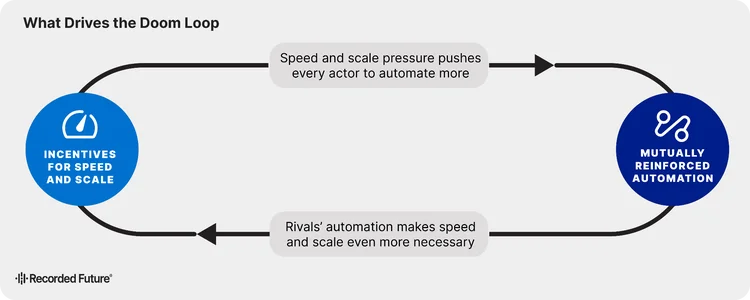
Hiring has long used software to handle application volume and support efficiency. Generative AI has changed the scale of the exchange: candidates can produce tailored applications quickly, while employers use AI to sort through the resulting flood. Greenhouse CEO Daniel Chait has described the cycle as a “doom loop.” No single decision set out to remove people from hiring. Instead, automation on one side encouraged more automation on the other. The result is a feedback cycle: each side adapts to the other’s tools, and the process gets harder to manage by hand.
The figures suggest a system under pressure. One survey of hiring managers found that applicants per hire tripled between 2021 and 2024. Greenhouse reported a 412% increase in applicants per job posting. Job seekers are also likely to use generative AI to prepare customized applications for large numbers of openings. Those figures describe different measures, but they point in the same direction: employers are receiving more material to review, while each application may take less effort to produce. More applications don’t necessarily mean more qualified candidates; they do mean that screening systems face a larger sorting task.
Employers have responded with more automated screening. Ninety-one percent of HR departments say they use AI in recruitment, while Greenhouse data indicates the number of human recruiters has fallen by more than half. The remaining recruiters face too many applications to assess each one closely. Some employers now use AI to conduct interviews, so candidates may not speak with a person at the company until late in the process—or at all. That shifts the human role toward reviewing what automated stages have already surfaced, a task that can be difficult when the earlier decisions are opaque or the queue is large.
More automation hasn’t delivered a faster process
The efficiency gains remain uncertain. Just one-third of recruiters surveyed said AI had shortened time-to-hire; a quarter said hiring took longer. The gap between promised efficiency and reported results matters. A tool can reduce the time spent on one step while adding review, correction, or follow-up elsewhere. If the process still depends on people to resolve unclear matches or check questionable decisions, faster sorting alone may not shorten the time to a hire.
Some companies are extending probation periods, which may point to difficulty identifying poor fits earlier. Job seekers have also described frustration with bot-led interviews. And when more of the process runs automatically, scammers and state-sponsored cybercriminals can exploit it to advance candidates seeking to steal secrets or cryptocurrency. These are different problems, but they expose a shared weakness: a process optimized to move quickly can leave less room to identify unusual cases, verify claims, or give candidates a meaningful chance to explain themselves.
Hiring was especially exposed because employers had already adopted tools such as keyword filters, and resumes and cover letters often follow patterns that generative AI can reproduce. That made it relatively easy for candidates to produce applications tailored to the visible signals of a screening system. When applicants adapt to those signals, automated filters may receive more of the same language and formatting, making it harder to distinguish fit from polish. The forces behind the cycle apply beyond recruitment:
- Rewards for speed and volume: When competition rises, applicants have an incentive to send more applications, faster. The same logic appears in other high-volume workflows: people respond to the rules and incentives they can see, even when those responses make the system less useful for everyone involved.
- Automation that encourages more automation: As volume exceeds what people can handle, organizations automate additional steps. Candidates then focus on satisfying screening systems instead of connecting with future colleagues. Each new layer can address the pressure created by the previous one, while making the overall process harder to inspect.
What the cycle means for AI agents
That pattern matters for AI agents in any high-volume workflow. Adding a human checkpoint after decisions have already been compressed into a machine-speed queue may leave people with little time or context to exercise real oversight. A person who sees only a score or a short summary may not have enough information to challenge the result. Human involvement can then become a procedural step rather than a meaningful chance to alter an outcome. This is more significant than it looks: oversight depends on access to relevant context and enough time to use it.
Leaders need to define the outcome they want, identify where a person’s judgment can change it, and consider how automation affects the behavior of everyone else in the process. If you’re working in this space, ask what people will be able to see when they review an agent’s work, and whether they can pause or redirect the process when something looks wrong. Here’s the thing: a human review point only helps if the reviewer has both the authority and the practical capacity to act. (And this is the part most people overlook.) The design of the queue, the information shown to reviewers, and the incentives facing users all shape whether that authority is real.
The hiring example suggests that safe automation depends on more than placing a human somewhere in the loop. Systems need to keep agents within human-authorized goals and provide meaningful opportunities to intervene where mistakes carry serious consequences. Speed is useful when the task can absorb it; where it can’t, the process must make room for human judgment. That may mean accepting slower handling in parts of a workflow where the cost of a mistaken decision is high. A checkpoint with no time to think. That’s oversight in name only.