Harnessing AI and Threat Intelligence: A New Era for Cyber Defense
The Convergence of AI and Threat Intelligence
Artificial intelligence (AI) is frequently recognized for enhancing cybersecurity workflows through automation, but that's only part of the picture. The most transformative aspect emerges when AI intersects with threat intelligence, specifically insights regarding adversarial capabilities and the vulnerabilities within one's defenses. This fusion creates a new defensive paradigm that can meaningfully reduce the long-standing advantage attackers have enjoyed over defenders.
Understanding the Defender's Challenge
Cybersecurity has long operated under a fundamental imbalance: defenders are tasked with safeguarding every potential attack vector, whereas attackers need only identify a single exploitable vulnerability. This discrepancy becomes even more pronounced given the budgetary limits, compliance requirements, and operational constraints that defenders face, while attackers can afford to be patient and selective.
Shifting from Automation to Intelligent Action
While automation has indeed streamlined a variety of security processes—such as rapid alert triage and enhanced incident response—it often merely extends pre-existing systems rather than redefining them. Processes like threat intelligence ingestion have become more efficient, but they fail to alter the core capabilities available to defenders. True transformation occurs when AI is leveraged not just for speed but for superior understanding of threats in real-time.
Transformative Capabilities of AI-Driven Defense
1. Real-Time Risk Assessment
The integration of AI with threat intelligence offers unprecedented capabilities for mapping adversarial tactics, techniques, and procedures (TTPs) against an organization's actual exposure. A conventional threat intelligence report may indicate potential vulnerabilities, but the time-intensive task of evaluating existing defenses traditionally falls to human analysts. However, AI can facilitate continuous, automated cross-referencing between identified threats and an organization's environment, delivering prioritized and actionable insights for risk management.
2. Unified Insights on Threat and Vulnerability
Historically, organizations have compartmentalized their knowledge concerning external threats and internal vulnerabilities. With AI, these streams can merge, providing a holistic picture of potential risks. By synthesizing external intelligence and internal weakness data, organizations can gain insights that shift the focus from merely generating vulnerability lists to a comprehensive understanding of how adversarial capabilities intersect with specific gaps in their defenses.
3. Proactive Vulnerability Management
Traditional methods of vulnerability prioritization often rely on fixed scoring systems that do not account for real-time exploitation trends. AI can redefine this approach by offering a more contextualized view of vulnerabilities based on current threat activity. It allows organizations to prioritize patching efforts according to vulnerabilities actively being targeted, ensuring that defenses are aligned with real-world conditions.
4. Enhanced Detection Capabilities
Detection systems typically rely on rules that correlate various events against established baselines. In contrast, AI-equipped systems can analyze anomalies in a more integrated manner, taking into account extensive data channels and past incidents. This advanced reasoning approach enhances the relevance and accuracy of detections by anchoring them in the context of known adversarial behaviors.
5. Dynamic Attack Path Evaluation
With AI, organizations can maintain an up-to-date model of their environment, continuously evaluating potential attack vectors as conditions change. Integrated with threat intelligence, this model offers a live overview of vulnerabilities most likely to be exploited, enabling defenders to remain ahead of threats instead of reacting only once incidents occur.
6. Predictive Insights During Incidents
In the midst of an active incident, experienced analysts leverage collective knowledge to anticipate an attacker's next moves. AI can augment this understanding by providing predictions about aggressors' strategies, allowing defenders to take preemptive measures that mitigate potential damage while an attack unfolds.
Redefining Deceptive Strategies
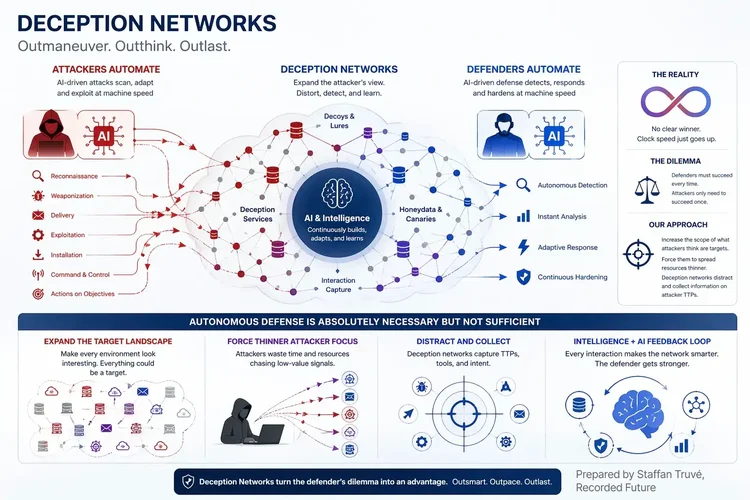
The combination of threat intelligence and AI doesn't just enhance defensive tactics; it opens new avenues for deception. Traditional deception methods, such as honeypots, often suffer from limitations in realism and adaptability, making them easier for astute adversaries to detect. Today, AI can generate dynamic deception environments that evolve in real-time to maintain realism and engage attackers effectively.
Adaptive Deception Mechanisms
AI allows for more sophisticated decoy deployments that mimic authentic systems, creating an environment that is less predictable and easier to navigate for attackers. Coupling insights on adversarial TTPs with strategic decoy placement can enhance the effectiveness of these deception tactics by aligning them with known attacker behaviors.
Counters That Impair Attackers
Utilizing AI-generated deception changes the dynamics of the cybersecurity battle. Attackers must now allocate significant resources to discern between real and fake assets, which disrupts their operations and increases their risk of detection. This inversion of the traditional defender's dilemma—where defenders managed static resources while attackers only required one weakness to succeed—complicates the aggressors' strategies.
Intelligence-Driven Defense for All
The introduction of AI as a tool for threat intelligence democratizes access to defensive strategies. Security teams can now use straightforward queries to obtain actionable insights without requiring specialized knowledge. This empowers all team members, not just analysts, to engage with threat intelligence effectively, reshaping the operational framework for cybersecurity.
Strategic Reshaping of Cyber Defense
The integration of AI and threat intelligence offers defenders the ability to operate more proactively, shifting their reactive stance to one of informed anticipation. Rather than struggling with antiquated assumptions about the nature of attackers' strategies, organizations can continuously evaluate their weaknesses in the context of current threat landscapes, allowing them to allocate resources strategically.
The Future Landscape of Cybersecurity
The advent of fully autonomous AI systems on both sides of the cybersecurity equation presents both challenges and opportunities. As attackers develop AI capabilities to enhance their offensive actions, defenders will similarly need to leverage AI's advantages to remain competitive. While the fundamental imbalance may never be entirely erased, organizations willing to invest in these intelligent capabilities can move closer to achieving parity. This shift could ultimately redefine the adversarial relationship in cybersecurity, making the execution of skills, preparation, and strategic planning far more critical than simply outgunning an opponent.