April 2026 Vulnerability Insights: Key Threats and Exploitation Patterns
During April 2026, Insikt Group® uncovered 37 significant vulnerabilities requiring urgent attention, with 35 assessed as having a Very Critical Recorded Future Risk Score. This marks a 19% increase in vulnerabilities from the previous month, underscoring the escalating risks organizations face. As cybersecurity continues to be a major concern for businesses, this uptick signifies a growing challenge in safeguarding sensitive information. Each new vulnerability can open the door to breaches that may have severe financial and reputational repercussions.
A substantial number, 31 out of these 37 vulnerabilities, were listed in the US Cybersecurity and Infrastructure Security Agency’s (CISA) Known Exploited Vulnerabilities (KEV) catalog. Six vulnerabilities were identified through honeypot data, which are exclusive to Recorded Future customers. Honeypots, essentially traps for cyber attackers, help organizations gain insights into attack methods and could be integral for developing preemptive strategies. This emphasis on real-world exploitation strengthens the timeliness and relevance of the vulnerabilities identified.
These vulnerabilities affected products from 23 different vendors, with Microsoft representing about 22% of the identified exposure. The remaining risks were spread across various enterprise-focused vendors, particularly within security, system management tools, collaboration platforms, server software, application delivery systems, remote support solutions, and network-edge devices. Using a diverse array of services means that a single flaw can have cascading effects across multiple systems and both internal and external infrastructures, making it essential for companies to foster a comprehensive vulnerability management framework.
Identifying Vulnerabilities: Crafted Templates for Detection
In response to emerging threats, Insikt Group developed Nuclei templates for detecting missing authentication vulnerabilities, specifically for Nginx UI (CVE-2026-33032) and Marimo (CVE-2026-39987). These resources are also available exclusively to Recorded Future clients. By targeting missing authentication pathways, which have often been the Achilles' heel for many systems, the templates are a proactive measure to enhance defense mechanisms. With attackers frequently exploiting such gaps, tools like these can empower security teams to close potentially harmful entryways before they are exploited.
Overview of Actively Exploited Vulnerabilities
The table below captures the 31 vulnerabilities that were actively exploited in April 2026, excluding the six that emerged from honeypot data. Examples of public proof of concepts (PoCs) associated with these vulnerabilities are included but have not been verified for accuracy or effectiveness, emphasizing the need for cautious evaluation by vulnerability management teams.
Score
✓
(available to Recorded Future customers)
Table 1: Documenting vulnerabilities that were actively exploited in April based on Recorded Future data (excluding honeypot-sourced CVEs).
Emerging Patterns: Analyzing April 2026
- Of the 37 vulnerabilities highlighted, seven were connected to ransomware activities, with six traced back to Storm-1175's Medusa ransomware operations. Given that ransomware has become a lucrative avenue for cybercriminals, the connection between these vulnerabilities and active ransomware campaigns raises alarms.
- Sixteen of the vulnerabilities enabled remote code execution (RCE) across products from twelve vendors, showcasing a troubling trend in exploitability. Remote code execution remains one of the most severe forms of vulnerability—allowing attackers to manipulate systems from afar—and indicates a pressing need for organizations to prioritize patch management.
- Public proof-of-concept (PoC) exploits were identified for 24 vulnerabilities, revealing transparency but necessitating vigilance. The existence of public PoCs can act as both a warning sign and a playbook for attackers, further complicating the landscape for defenders.
- Commonly exploited weaknesses included path traversal, code injection, improper input validation, and missing authentication. These issues are not new; they reflect persistent weaknesses that organizations must address through rigorous testing and training.
- Surprisingly, three vulnerabilities are five years old or older, highlighting the persistent exploitation of long-standing issues in environments with patching delays. This trend points to a systemic problem; when organizations fail to keep their systems updated, they become easy targets.
Highlighted Exploitation Activity
This section focuses on vulnerabilities that had significant impacts in April, particularly those associated with active threat campaigns or with available public PoCs. Such vulnerabilities deserve more scrutiny, as they often serve as a gateway for broader attacks.
Nexcorium Botnet Targets TBK DVR Vulnerability
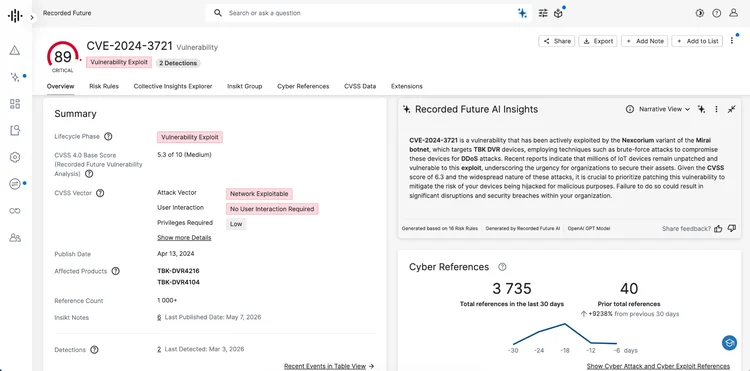
On April 17, 2026, FortiGuard Labs disclosed a campaign using CVE-2024-3721 to exploit TBK Digital Video Recorders, facilitating the delivery of the Nexcorium botnet. This vulnerability allows remote actors to execute arbitrary commands on vulnerable DVR devices, leading to compromised systems. The implications of such a leak are dire; anyone could gain access to surveillance feeds, creating both a privacy and security nightmare.
The exploit involved manipulating certain arguments in TBK DVR to deliver a downloader script named dvr, which retrieves compiled attacks for various architectures. For full technical details, including indicators of compromise, Recorded Future customers can refer to Insikt Group reports. This kind of multi-faceted attack requires a steadfast response from organizations, and without rigorous oversight, such vulnerabilities could continue to pose severe risks.
Future Implications: The Path Ahead
As cybersecurity threats grow, organizations must shift their focus from reactive measures to proactive strategies. The statistics from April indicate not just isolated incidents but a broader trend that could reshape how businesses operate. If you’re working in this space, you’ll want to prioritize vulnerability management not just as a compliance checklist, but as an essential facet of your overall security architecture.
In practical terms, this means continuously monitoring for vulnerabilities, investing in training for your teams, and staying informed about emerging threats. The sheer scale of vulnerabilities reported means that it’s not just about patching the most critical ones; businesses need a holistic, comprehensive strategy for cybersecurity. As the threat environment continues to evolve, a proactive rather than a reactive stance may just be your best defense.
With cyber threats proliferating, it's clear that organizations can no longer afford to be complacent. The vulnerabilities discovered this month are a stark reminder of the potential consequences of oversight. Organizations that fail to address these issues risk harsh repercussions, both financially and in terms of their reputation. Awareness and preparation have never been more vital.