Critical Vulnerabilities Surge: Insights from June 2026 Cybersecurity Trends
June 2026 has proven to be a notable month in the cybersecurity domain, with Insikt Group® reporting a staggering 59 high-impact vulnerabilities requiring urgent attention. Out of these, 30 vulnerabilities received a ‘Very Critical’ score from Recorded Future, translating to a substantial 47% increase in identified risks compared to the previous month.
These vulnerabilities affected products from 36 different vendors, with Microsoft prominently contributing to around 17% of these issues. The remaining vulnerabilities were widely distributed across various sectors including enterprise software, security frameworks, network infrastructure, developer tools, and cloud service providers. Such dispersion reflects the increasing complexity and targeting of modern IT environments.
Noteworthy Vulnerabilities and Detection Techniques
Among the critical vulnerabilities identified, Insikt Group developed Nuclei templates to assist in the detection of two specific issues: CVE-2026-35616 impacting Fortinet FortiClient EMS and CVE-2026-25939 concerning Frangoteam FUXA. These templates are now accessible to clients via the Recorded Future Intelligence Operations Platform, enhancing the toolset available for cybersecurity professionals aiming to mitigate these risks.
The report does not merely emphasize the number of vulnerabilities but provides a quick reference guide highlighting an alarming trend: a significant majority of these vulnerabilities were actively exploited in June 2026. The included table presents 56 vulnerabilities, intentionally excluding three associated with honeypot activity, thus focusing on real-world exploitation scenarios.
Exploitation Trends in June 2026
- Among the vulnerabilities identified, an astonishing 25 enabled remote code execution (RCE). The implicated vendors included notable names such as Meta, WinRAR, Ivanti, Google, and Cisco.
- Insikt Group pinpointed public proof-of-concept (PoC) exploits for an impressive 53 out of the 59 vulnerabilities, showcasing the urgency of threat mitigation for organizations.
- The month revealed the most frequently observed vulnerability types, including path traversal and deserialization of untrusted data, which continue to pose security dilemmas for many systems.
- Alarmingly, historical vulnerabilities remain a significant concern, with four vulnerabilities being at least five years old, exemplifying the chronic delay in organizational patching practices. It is worth noting that some vulnerabilities were exploited less than a day after disclosure, underscoring the swift pace of cyber threats.
Malware-Related Exploitation Activities
The month pointed to a prevalent trend of targeting enterprise applications via external exploitation. Insikt Group launched an investigation into the StrikeShark campaign which effectively demonstrated how vulnerabilities like CVE-2025-55182 can be leveraged to deliver malicious payloads. This includes a string of well-known vulnerabilities targeting Microsoft Exchange servers and other widespread systems.
In this campaign, threat groups such as Lazarus were observed leveraging vulnerabilities linked to critical applications, deploying advanced malware variants like Cobalt Strike and COPPERHEDGE against financial and blockchain enterprises. Additionally, various security exploits targeting Cisco and Fortinet products were also revealed, demonstrating a concerted effort by attackers to breach commonly used infrastructures.
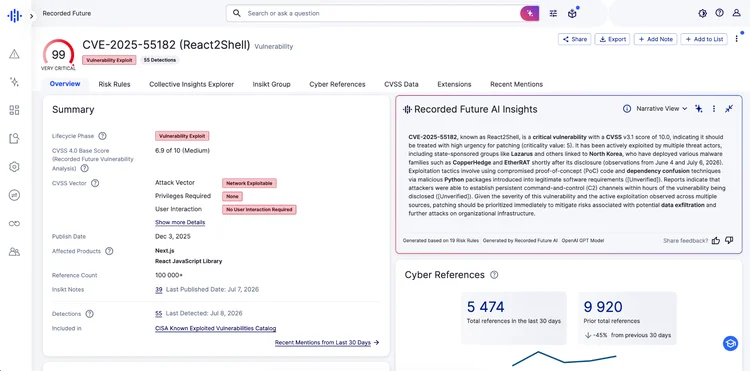
Figure 1: Vulnerability Intelligence Card® for CVE-2025-55128 (React2Shell) available from Recorded Future.
Moreover, APT36 was active in exploiting vulnerabilities in Microsoft’s suite, especially targeting Windows client and server versions, illustrating how threat actors take advantage of software ecosystems.
Insights and Future Directions
The data compiled for June 2026 presents a clarion call for organizations to prioritize their cybersecurity protocols. With the rapid increase in vulnerabilities being actively exploited and the year-on-year escalation of threat sophistication, it's imperative that companies reassess their vulnerability management strategies.
Public proofs of concepts are integral to understanding the exploitability of vulnerabilities, yet they must be approached with caution; effective verification is essential before attempting any remediation based on untested PoCs. Furthermore, the historical vulnerabilities highlight a broader issue of systemic vulnerabilities persisting in production environments, suggesting a need for more robust patch management policies.
In essence, the cybersecurity community must align its efforts with real-time data insights and preventive measures to guard against the ever-evolving landscape of cyber threats. By focusing on immediate remediation and bolstering security frameworks, organizations can enhance their resilience against imminent attacks.