Unlocking Conversational Analytics: A Comprehensive Look at Google Cloud's Advancements
Generative AI is making strides across enterprises, but successful adoption hinges on more than just implementing a chatbot with a user-friendly interface. Organizations need reliable interactions with their critical databases, built on a foundation of trust and clear governance based on enterprise semantics.
Over the past year, Google Cloud has transitioned Conversational Analytics from being a niche experiment to a fully-integrated solution deployed across various enterprises. Key features like BigQuery Conversational Analytics and the Conversational Analytics API are now available, complementing the already launched capabilities in Looker. Building on this momentum, Google has also introduced Conversational Analytics in Databases, currently in preview, further expanding the tools available for businesses to manage and analyze their data.
Unified Querying Across Multiple Platforms
One of the most significant enhancements is the general availability of Conversational Analytics for both BigQuery and Looker, with preview support for AlloyDB, Cloud SQL, and Spanner. This means businesses can analyze data spread across various environments, whether it's solely on Google Cloud or spread among different cloud providers. Agents can now query and analyze data stored in Lakehouse Managed Service tables, Apache Iceberg REST catalogs, and more.
For data professionals, Conversational Analytics boasts direct integration into various data platforms like BigQuery Studio, Database Studio, and the Data Agent Kit. Business teams benefit as these conversational capabilities extend into tools like Looker and Data Studio, enabling complex queries while maintaining centralized governance through Gemini Enterprise.
The API capabilities allow organizations to embed Conversational Analytics where their teams work. Whether through custom applications or multi-agent systems, users might interact with a Slack bot that can address questions from multiple data sources.
Enhanced Governance and Security Measures
As enterprises scale up generative AI usage, robust governance and effective cost management are essential. Conversational Analytics incorporates unique features like Customer Managed Encryption Keys (CMEK) and private cloud options, all designed to bolster security.
Google provides guarantees for data residency within the EU and U.S., ensuring compliance with regulations like HIPAA. Role-based access controls, such as parameterized secure views, help regulate what data is visible to users during conversational interactions, thus safeguarding sensitive information.
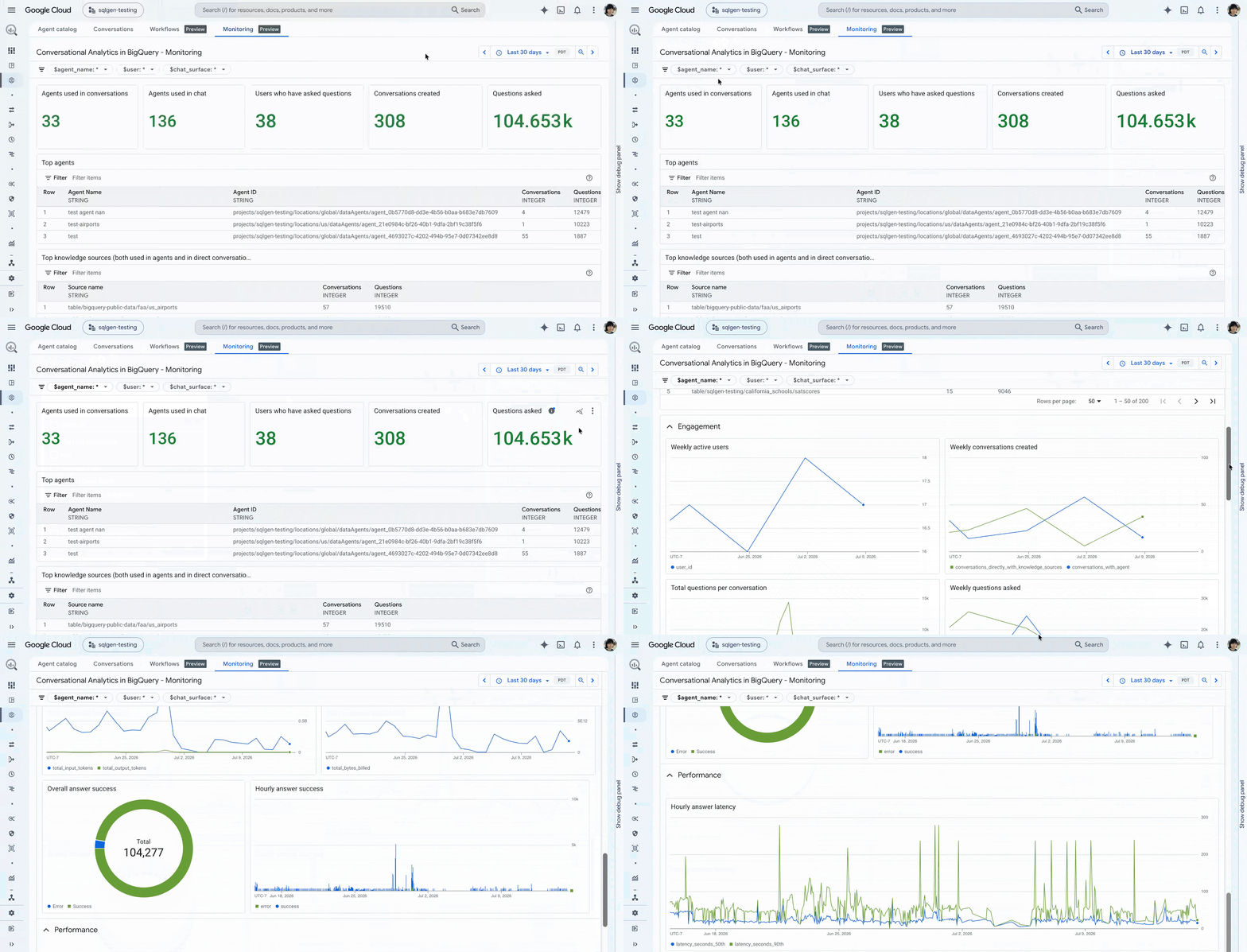
Monitoring Conversational Analytics in BigQuery for insights into user engagement and data query trends.
As adoption increases, administrators are equipped with tools to track system health and manage costs. Organizations can configure native controls to limit query sizes and monitor usage via BigQuery labels and Looker activity logs. Agents can also export metrics regarding system performance and resource consumption, creating opportunities for continuous improvement based on user feedback.
Co-Designed Context for Enhanced Accuracy
One challenge in integrating LLMs with enterprise databases is the risk of inaccurate outputs. To counter this, Google has co-designed Conversational Analytics agents to work closely with the platforms they access. These agents utilize resources like the Knowledge Catalog for efficient data discovery and context enrichment, ensuring that queries remain accurate.
With features such as BigQuery Graphs and Spanner Graphs, agents can understand relationships within various data types. This co-design ensures that responses are not only accurate but are also supported by data governance principles through Looker's semantic layer (LookML).
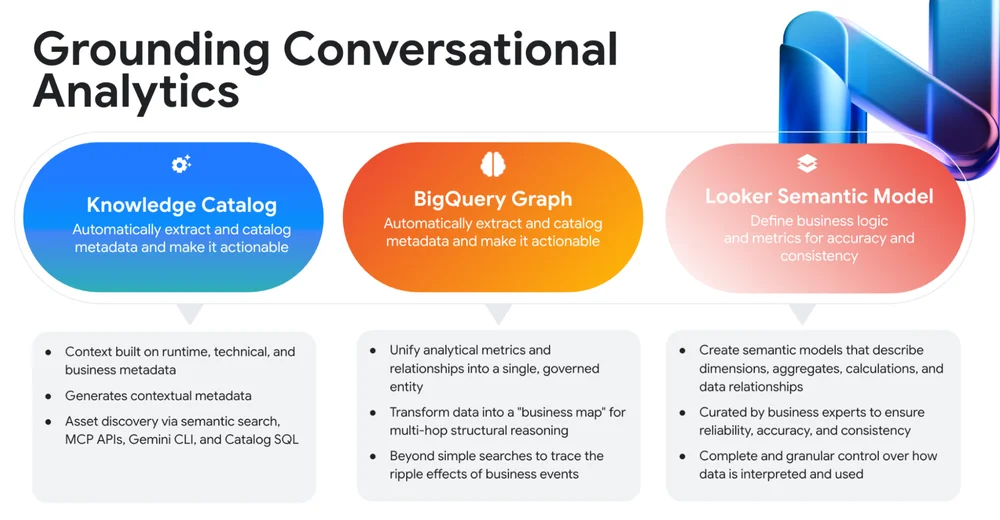
Leveraging interconnected tools to ground Conversational Analytics for reliable corporate data responses.
Integrated functionalities also allow for multimodal data querying, where agents can use commands like ai.search or ai.detect_anomalies effectively for deeper analytical insights. When combined with Looker’s semantic capabilities, these agents ensure responses are well-founded and relevant, minimizing guesswork in data interactions.
Proactive Analytics with Agentic Workflows
The shift from reactive to proactive analytics is another transformative aspect of Conversational Analytics. Instead of waiting for user prompts, agents can conduct multi-dimensional analyses to explore contributing factors of metrics automatically.
With the introduction of Agentic Workflows, teams can set up automated reporting routines that deliver insights right into their chat interfaces. These agents can execute anomaly detections continuously, sending updates on key metrics based on specified thresholds.
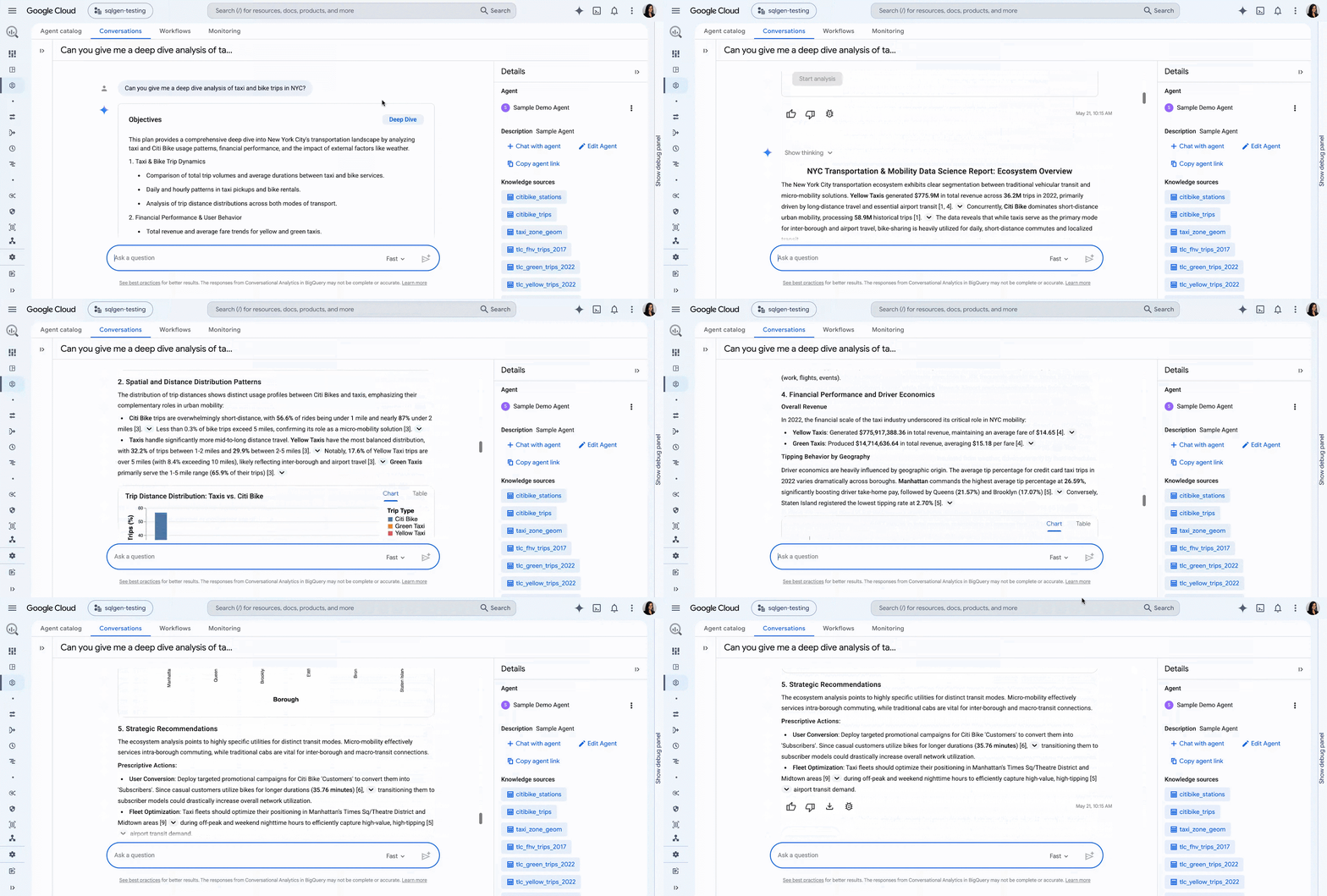
Initiating complex data investigations through Conversational Analytics to uncover insights across diverse datasets.
Developer-Friendly Integration and Getting Started
Conversational Analytics enhances flexibility for developers and business users, allowing integration into their workflows easily. The API comes with native SDKs for several programming languages, ensuring efficient deployment in existing tools like Looker Dashboards and Data Studio.
Moreover, developers can utilize the Agent Development Kit (ADK) alongside the Model Context Protocol (MCP) to embed Conversational Analytics into other applications, whether they be custom solutions or essential communication tools like Slack. This versatility allows for specific use cases, such as calculating financial impacts in real-time across the supply chain.
Google Cloud's Conversational Analytics offers a gateway to enriched data interactions, security frameworks, and developer APIs tailored for proactive insights. Teams can begin their journey by visiting the documentation, exploring quickstart options, and signing up for previews to experience these advancements firsthand.